
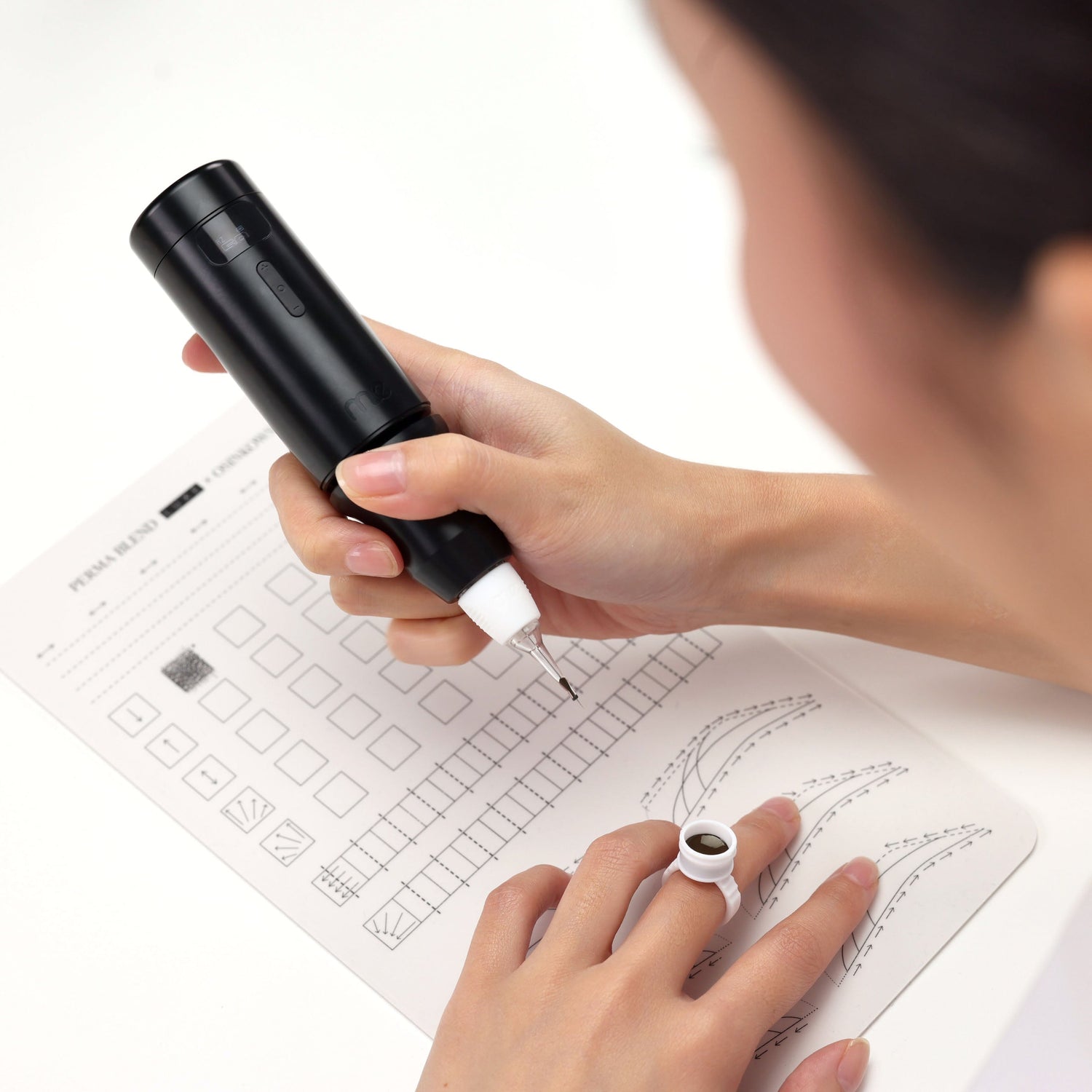
Your hands are the most important tool in your work. They allow you to perform precise and controlled movements, but at the same time, they are constantly exposed to one of the most underestimated risks in the permanent makeup industry: mechanical vibration.
Most artists are taught how to hold the device correctly or how to reduce hand tension, but very few are aware of micro-vibrations — the subtle yet continuous oscillations that, over time, damage joints, nerves, and muscles. Their effects are not visible immediately, but with repeated exposure, they can lead to chronic overload and serious occupational disorders.
How Vibrations Affect the Body
From an engineering and medical point of view, vibration is a mechanical oscillation transmitted from the device through the hand and arm into soft tissues.
In PMU devices, vibrations are generated by the rotating shaft and eccentric cam, and then transferred through the housing directly into the artist's hand.
Even low-intensity vibrations, when experienced for many hours every day, can cause microtrauma, circulatory problems, and nerve irritation that accumulate over time.
Hand–Arm Vibration Syndrome (HAVS)
Hand–Arm Vibration Syndrome (HAVS) is a well-documented occupational condition recognized by the World Health Organization (WHO) and the European Agency for Safety and Health at Work (EU-OSHA). It develops gradually due to long-term exposure to vibration transmitted from handheld tools.
Common symptoms include:
- Tingling or numbness in the fingers
- Reduced grip strength
- Pain and stiffness in the joints of the hand and wrist
- Circulatory problems, known as "white finger syndrome," caused by vascular spasms
In advanced stages, blood vessels and peripheral nerves lose their normal function. This results in permanent loss of sensation and dexterity — a serious problem for professionals who depend on precision.
Carpal Tunnel Syndrome (CTS)
Continuous exposure to vibration can also lead to Carpal Tunnel Syndrome (CTS) — compression of the median nerve inside the wrist. Constant vibration and repetitive motion increase pressure within the carpal tunnel, causing inflammation and nerve compression.
Early symptoms: pain, tingling, and numbness in the thumb, index, and middle fingers.
Later stages: reduced grip strength, loss of fine motor control, and, in many cases, the need for surgery.
Both HAVS and CTS are among the most common occupational disorders in precision-based professions — including dentistry, micro-electronics, tattooing, and permanent makeup.
The Engineering Perspective – Where Vibrations Come From
In PMU machines, vibrations result from mechanical imbalance or lack of precision in the drive system. The main causes include:
- Unbalanced or asymmetrical eccentric cam
- Incorrect bearing alignment or excessive clearance
- Low rigidity of the internal structure
- Unstable motor speed (typical for basic DC motors without PWM or encoder control)
- Poor cartridge fit, which introduces additional movement
Even minimal imbalance or axis misalignment increases vibration amplitude — and that energy is transmitted directly to the hand.
High-quality devices are designed to minimize this effect through:
- Dynamically balanced eccentric systems
- High-grade bearings (ABEC-5 or higher)
- Rigid construction to absorb vibration
- Brushless motors with PWM or encoder-based speed control for stable rotation under load
These engineering choices don't just make the device feel smoother — they reduce the amount of mechanical energy transmitted to the hand, protecting the artist from long-term damage.
Why Reducing Vibrations Was a Design Priority for ME™
From the first engineering sketches, the goal was not only to increase performance and precision, but also to protect the artist's hand from mechanical overload. That's why:
- The internal components were dynamically balanced
- Reactive forces on the wrist were minimized
- The housing was designed for ergonomic stability and long-term comfort
- Each element was optimized to direct energy into the needle movement — not into the hand
How Low Vibration Improves Your Daily Work
- Less muscle and joint fatigue during long procedures
- Reduced risk of injury and chronic pain
- Higher comfort, precision, and control
- A sustainable career without fear of losing hand function over time
Your hands can't be replaced. Protect them consciously — because without healthy hands, there can be no precision, no results, and no long-term career in permanent makeup.


Leave a comment
All comments are moderated before being published.
This site is protected by hCaptcha and the hCaptcha Privacy Policy and Terms of Service apply.