
No- and you shouldn't try to.
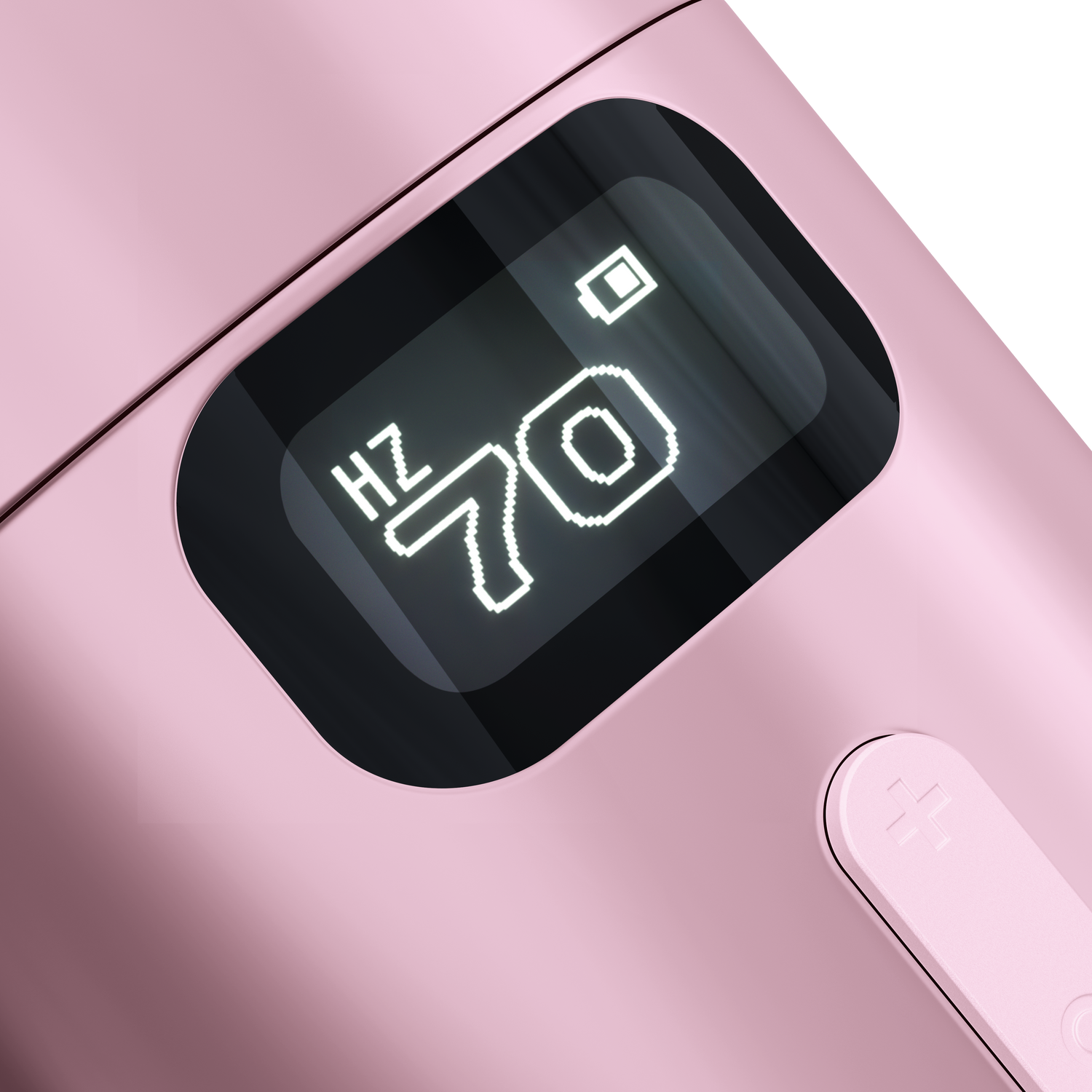
If you have always worked at 6 V, 7 V or 8 V on another machine, there is no formula that will tell you what this equals in Hz on ME™.
7 V does not equal 50 Hz, 60 Hz or any other specific frequency.
Even if you know the actual frequency of your previous machine, you still shouldn't expect two machines from different brands to behave identically at the same numerical speed.
Different motors, stroke lengths, mechanics, drive systems and motor control will change how the machine behaves and responds under load.
So when changing machines, don't try to translate the number. Learn the machine.
Start on latex and test different frequencies while keeping your movement as consistent as possible. Look at:
-
how fast your hand is moving,
-
how long each movement or segment is,
-
how many dots are deposited within that movement,
-
the spacing between those dots,
-
and whether that density matches the effect you want to create.
Then adjust the frequency up or down.
What if I want to copy the speed my trainer uses?
Don't copy only the number displayed on their machine.
Watch the movement that goes with it.
How long is one movement?
How quickly is the hand travelling?
How many implantation points are created during that movement?
How closely or widely are those points spaced?
For example, if your trainer creates a 1 cm movement at a particular hand speed and produces a certain number and spacing of dots, this gives you much more useful information than simply knowing that their machine was set to “7 V”.
Recreate the movement on latex and adjust your machine frequency until the relationship between machine speed + hand speed + movement length + dot spacing gives you a comparable result.
It may take several attempts. That's normal.
The goal isn't to find the numerical equivalent of someone else's setting.
The goal is to find the frequency that works with your hand speed and produces the implantation pattern and density you actually want.
The number is only one part of the equation
This is why asking another artist:
“What speed do you work at?”
will never give you the complete setting.
A more useful question is:
“What frequency are you using, and how does that frequency relate to your hand speed and movement?”
Machine frequency and hand speed work together. Change one while keeping the other constant, and you change the distance and density of the implantation points.
That's what you should learn to observe — instead of trying to convert one machine's numbers into another.


Leave a comment
All comments are moderated before being published.
This site is protected by hCaptcha and the hCaptcha Privacy Policy and Terms of Service apply.