
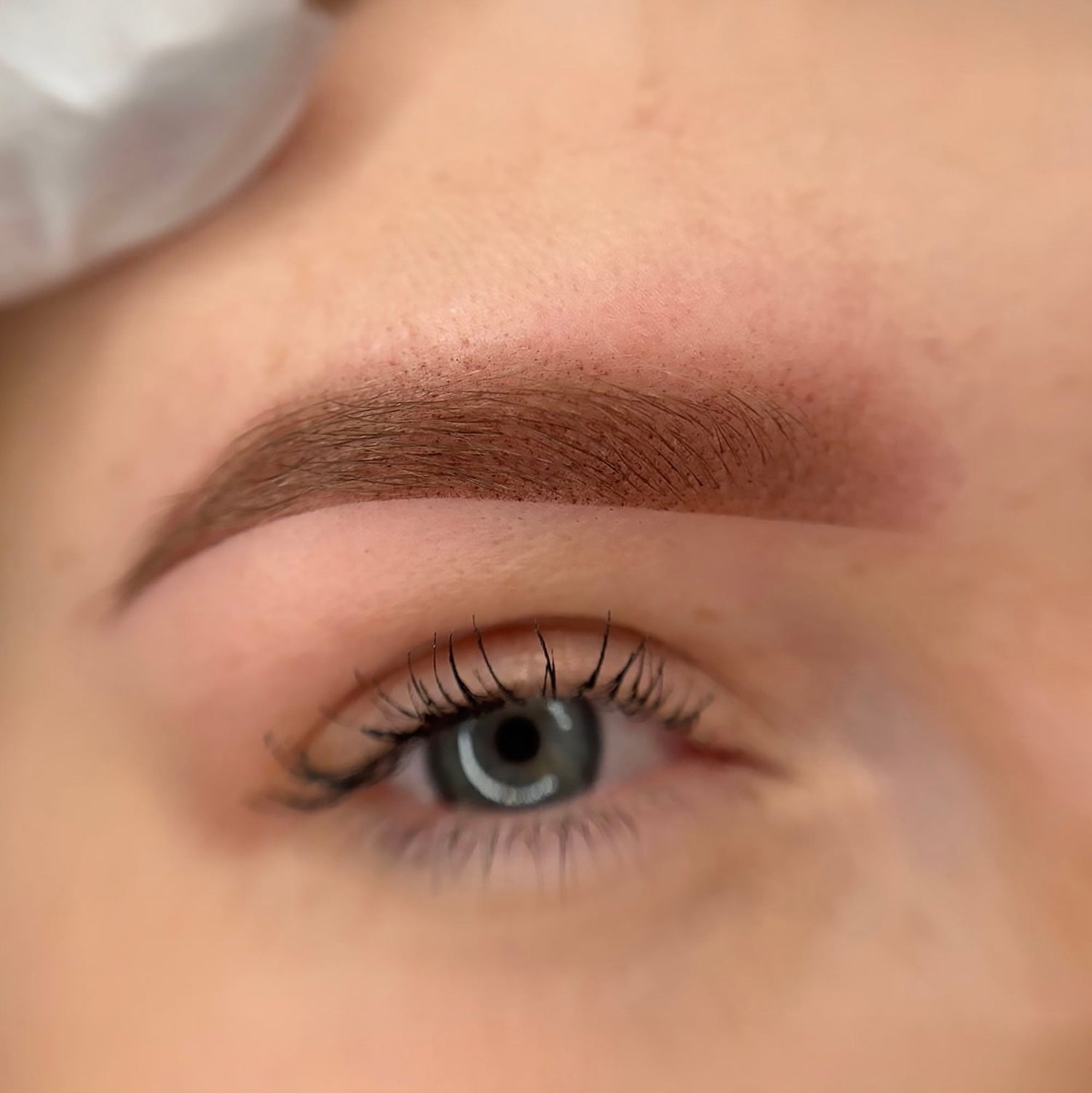
A good powder brow machine should help you achieve what every artist is looking for:
-
even saturation across the entire brow,
-
soft and smooth gradients,
-
clean individual dots,
-
minimal unnecessary skin trauma,
-
less swelling during the procedure,
-
predictable healed results.
-
reduce time needed for proceudre
These are the characteristics that ultimately determine the quality of powder brows.
The machine itself does not create beautiful brows. The artist does.
But the machine should make that process as predictable as possible, at the end of the day it's your hand exstantion.
Powder Brows Are Created One Dot at a Time
A powder brow is created by thousands of individual implantations.
Every dot contributes to the final healed result.
When those dots are placed consistently, the brow heals evenly.
When implantation becomes inconsistent, artists often notice:
-
patchy healing,
-
uneven saturation,
-
darker and lighter areas,
-
the need for additional passes,
-
unnecessary skin irritation.
For this reason, consistency is far more important than power.
Why Some Brows Heal More Evenly Than Others
Every artist has experienced procedures that seem effortless.
Pigment builds gradually.
The skin remains calm.
Saturation develops evenly from the first pass to the last.
Other procedures feel completely different.
The skin becomes irritated more quickly.
Pigment appears less predictable.
Additional passes become necessary simply to achieve even saturation.
Technique always plays an important role.
But during the development of ME™, we repeatedly asked another question:
How much of this difference comes from the way the machine behaves once the needle enters the skin?
That question became one of the foundations of our engineering process.
Living Tissue Does Not Behave the Same
One assumption often made in permanent makeup is that identical needle movement should produce identical results across every client.
Our observations suggested otherwise.
Living tissue is not mechanically uniform.
Young skin behaves differently from mature skin.
Highly elastic skin behaves differently from dense or fibrotic tissue.
Some skin accepts pigment gradually.
Some deforms more easily.
Some requires noticeably more compensation from the artist.
As tissue behaviour changes, the conditions under which the needle works also change.
This is why we stopped asking:
"How powerful is the machine?"
Instead we asked:
"How can needle behaviour remain predictable while tissue behaviour keeps changing?"
Why We Focused on Implantation Instead of Specifications
Most PMU machines are compared using specifications.
Stroke length.
Voltage.
RPM.
Motor type.
These parameters describe the machine.
They do not describe the quality of implantation.
During development, our objective was not to achieve the highest RPM or the highest voltage.
Our objective was to improve implantation efficiency.
In practical terms, that means helping artists achieve the desired saturation with fewer unnecessary passes, less pressure and less unnecessary tissue disturbance.
Because every additional pass transfers additional mechanical energy into the skin.
Not all of that energy contributes to pigment implantation.
Some of it simply increases tissue trauma.
Motion Control™ Was Developed for Implantation
One misconception is that different machine modes exist simply because artists prefer different sensations in the hand.
That was never our objective.
Motion Control™ was developed to change needle behaviour during implantation.
For powder brows we developed two different movement profiles.
Powder Motion™
Powder Motion™ is our most balanced and versatile Motion Control™ profile. The impulse is delivered in a neutral, controlled manner—it is neither distinctly soft nor distinctly direct. Sensory-wise, it sits between Satin™ and Hairstroke™. Designed to perform predictably across a wide range of powder brow techniques and skin types, it helps artists achieve even saturation, consistent pixel distribution and predictable healed results.
Satin Motion™
Satin Motion™ delivers a smoother, softer impulse throughout the implantation cycle. The needle movement feels more fluid, allowing pigment to build more gradually. This creates finer, softer-looking pixels and makes it easier to achieve delicate transitions and a refined satin finish. Many artists prefer Satin Motion™ when working on mature, delicate or thin skin, or whenever the goal is an exceptionally soft healed powder effect.
Why We Chose a Brushless Closed-Loop System
One of the engineering decisions behind ME™ was replacing the conventional brushed coreless architecture used in many PMU machines with a customized brushless motor operating in a closed-loop control system.
It monitors the behaviour of the drive system while treatment conditions change.
The objective is simple:
Help the needle behave as consistently as possible throughout the procedure.
Why Predictability Matters for Powder Brows
Predictable needle behaviour helps artists create:
-
cleaner individual dots,
-
more even saturation,
-
smoother gradients,
-
fewer unnecessary passes,
-
less unnecessary trauma,
-
calmer skin during treatment,
-
more predictable healed brows.
No machine can replace technique.
No machine can guarantee perfect healed results.
But a predictable machine allows experienced technique to be reproduced more consistently.
The Best PMU Machine for Powder Brows
The best PMU machine for powder brows is not necessarily the one with the highest RPM, the longest stroke or the most powerful motor.
It is the one that allows the artist to create thousands of consistent implantations while respecting the biology of the skin.
Beautiful powder brows are not created by aggressive implantation.
They are created by predictable implantation.
One dot at a time.

Leave a comment
All comments are moderated before being published.
This site is protected by hCaptcha and the hCaptcha Privacy Policy and Terms of Service apply.